NOT JUST A CATALOG, A MISSION DESIGN TOOL
Track any space object around Earth today and predict where it will be tomorrow.
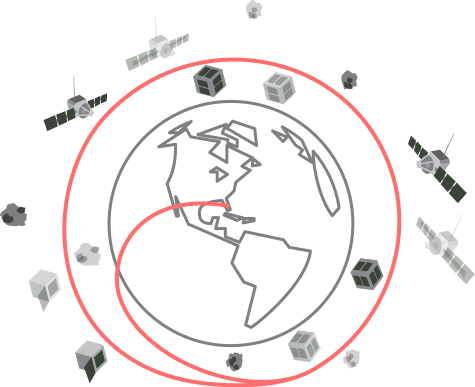
Everything you need to analyze & explore the orbital environment
Prograde provides real-time 3D orbit visualization, precise telemetry inspection, and NORAD catalog search for space engineering teams.
Real-Time 3D Globe Visualization
Interactive 3D Earth visualization displaying active spacecraft, payloads, and space debris fields across all orbital regimes.
Orbital Elements & Telemetry
Access precise Keplerian parameters (semi-major axis, inclination, RAAN, period) and position/velocity state vectors.
Instant NORAD Catalog Search
Search tens of thousands of cataloged space objects by NORAD ID or satellite name with real-time autocomplete.
UTC Timeline Scrubbing & Propagation
Propagate trajectories forward and backward in time with precise UTC epoch controls and time-lapse scrubbing.
Live TLE & Ephemeris Data Feeds
Integrated TLE datasets sourced directly from Space-Track and CelesTrak with automated catalog updates.
Space Domain Awareness
Analyze orbital paths, ground tracks, and spatial relationships to evaluate mission scenarios and conjunction risks.
Interactive 3D space domain awareness & orbit analytics
Explore satellite constellations, inspect exact orbital elements, and query the complete NORAD space object catalog in real time.
Real-time 3D orbital visualization & space environment
Render thousands of tracked satellites, active payloads, and space debris fields simultaneously around an interactive 3D Earth with precise UTC epoch propagation controls and time-lapse scrubbing across LEO, MEO, and GEO regimes.

Precise orbital elements & live telemetry inspection
Select any spacecraft (such as ISS ZARYA NORAD 25544) to instantly inspect Keplerian parameters (Semi-major axis, Eccentricity, Inclination, RAAN, Period), position and velocity state vectors, TLE propagation history, and live horizon trajectory projections.

Instant NORAD ID & spacecraft catalog search
Quickly search and filter tens of thousands of cataloged space objects by NORAD identifier or satellite designation with real-time autocomplete suggestions and one-click 3D target focus.

Engineered for modern space missions
Real-time satellite tracking, high-precision numerical propagation, and comprehensive orbital analytics.
Cataloged Space Objects
Active satellites, historical payloads, and debris tracked with NORAD identification.
Daily Trajectory Calculations
High-order numerical orbit propagations and state vector transformations.
Average LEO Orbit Period
Sub-second trajectory propagation and real-time epoch timeline scrubbing.
Platform Reliability
Dependable ephemeris data feeds and high-fidelity aerospace calculations.
Frequently asked questions
Everything you need to know about Prograde and our orbital analysis platform.
Prograde was designed for space startups, engineering teams, mission designers, researchers, students, and anyone who needs to understand the orbital environment.
No! Prograde was designed to make orbital analysis understandable even if you are not an astrodynamics specialist. More experienced users can benefit from accessing the underlying orbital parameters, state information, metadata, and technical outputs needed for deeper analysis.
Prograde includes known currently active and no longer active spacecraft, and space debris. Prograde can display objects available through its supported data sources. For this reason, some objects may be untracked, unlisted, classified, too small to be cataloged, temporarily missing, or represented by outdated or incomplete information. Catalog coverage and metadata quality may also vary between objects.
Prograde uses publicly available orbital and space object data from established sources such as Space-Track and CelesTrak, together with publicly available object metadata where appropriate.
Prograde retrieves updated information as new data becomes available from its underlying sources. Because different objects and data providers may update at different intervals, not every catalog entry will have the same age. Prograde displays data timestamps wherever possible.
Accuracy depends on the source data, its age, the propagation model, the selected analysis period, and the type of result being generated. For example, publicly available TLE or general-perturbations data can be valuable for catalog exploration and preliminary orbital analysis, but they are not a replacement for precision orbit determination or operator-provided ephemerides. Prediction uncertainty generally increases as an orbit is propagated farther from the source-data epoch. Prograde identifies relevant assumptions and limitations wherever possible so users can determine whether a higher fidelity analysis is required.
No. The current version of Prograde is primarily intended for accessible mission analysis, early design studies, education, research, and preliminary decision support. It is not intended to replace an operator’s flight dynamics system, navigation solution, conjunction assessment service, mission-control process, or regulatory and safety obligations.
Yes! The orbital catalog and visualization capabilities are only the beginning. New capabilities will be added progressively, with a focus on making technically meaningful analysis easier to perform and understand.
Prograde does not collect your information. It only retains information needed during your session, after which it is deleted. Authentication information and communications with the platform are protected using standard security practices, including encrypted connections. Prograde does not store or sell user-provided mission data. More detailed information about collection, retention, deletion, third-party services, and account rights are provided in our Privacy Policy page.
Still have questions?
Can't find the answer you're looking for? Please chat to our friendly team.